What the cheaper case costs after trimming and prep
Compare whole and prepared ingredients at the same usable output. Then separate time released in the kitchen from money that actually leaves the payroll.
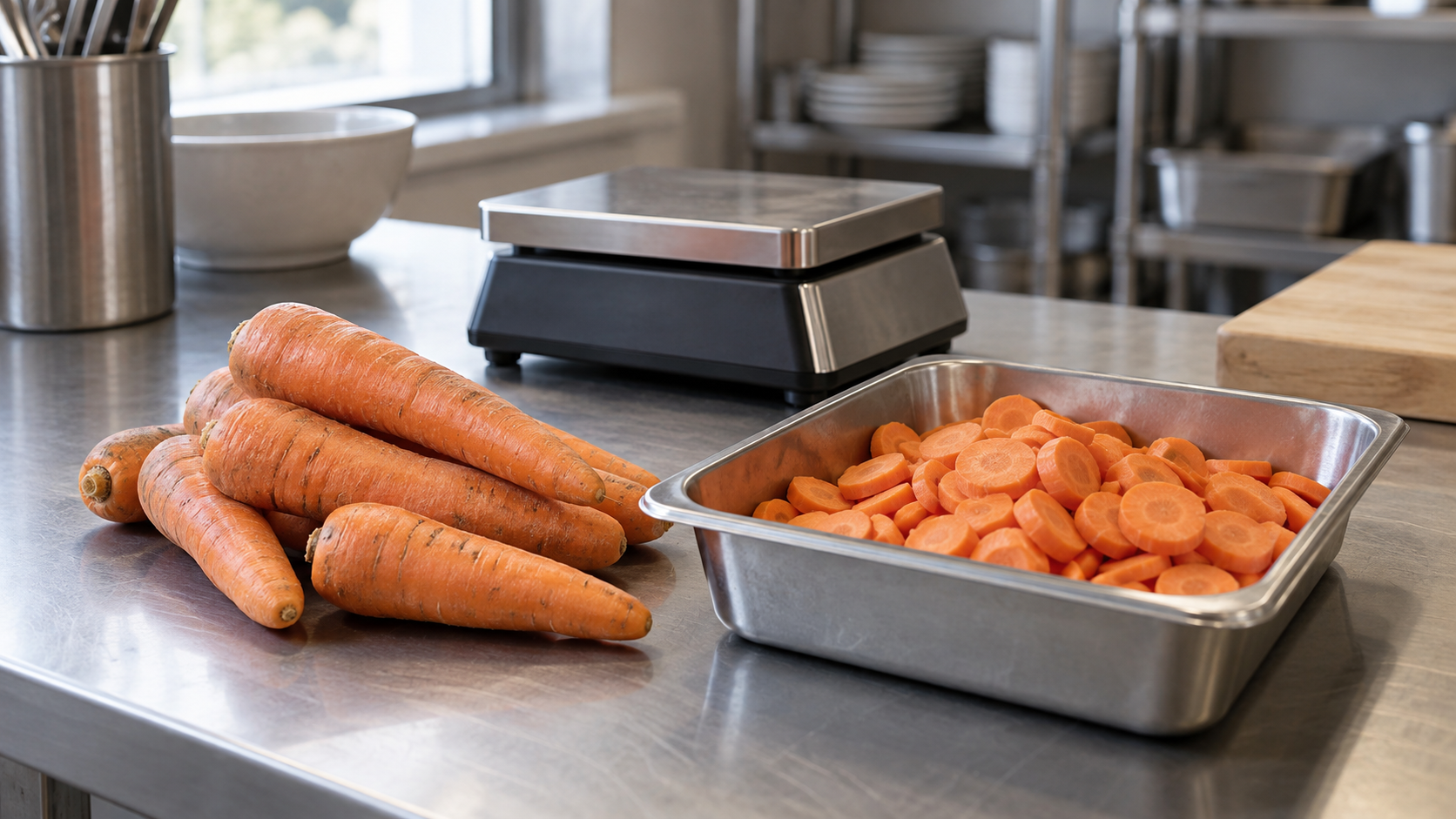
Put both purchase options on the same usable basis
View chart data and method
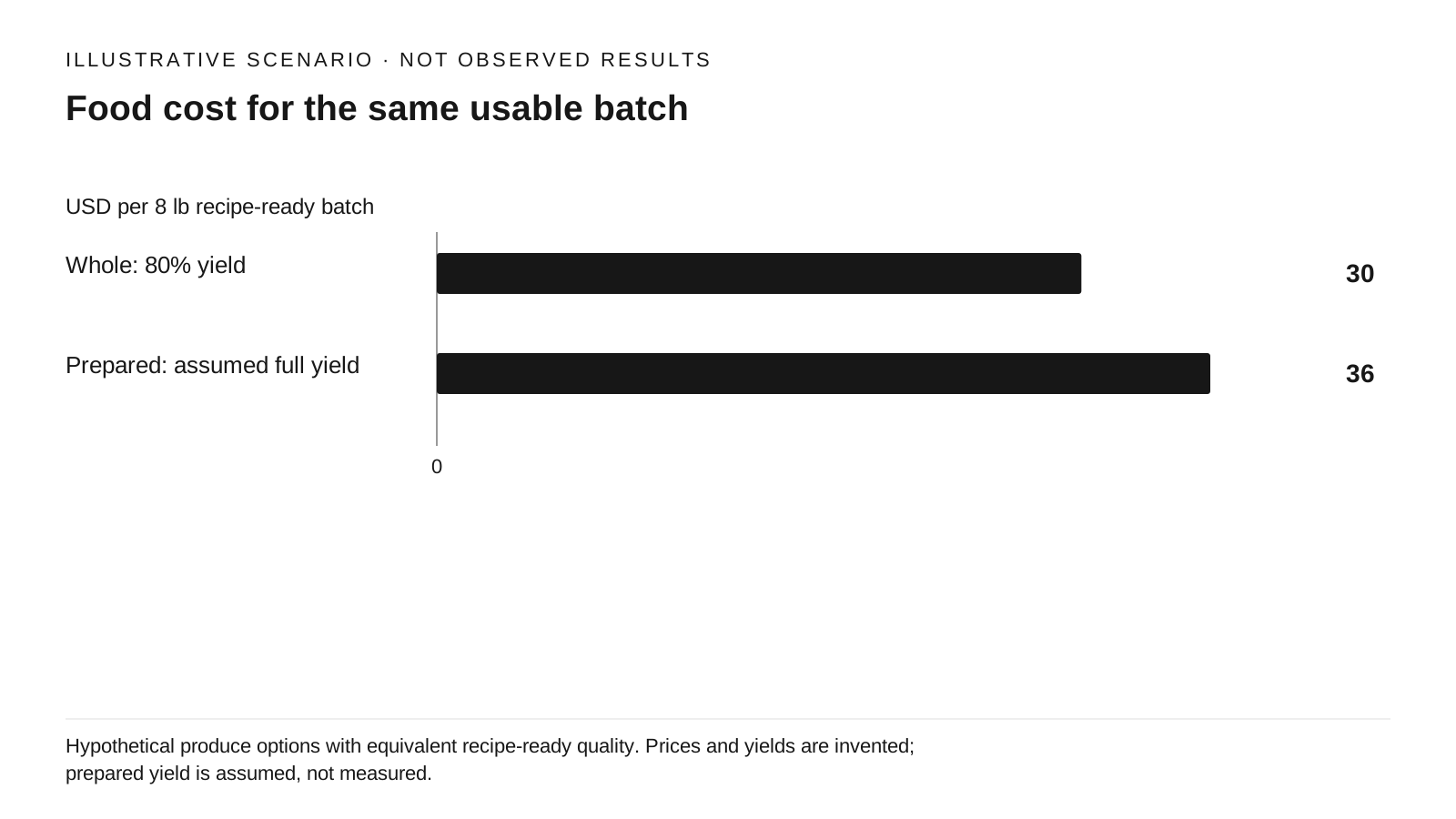
hypothetical scenario · USD per 8 lb recipe-ready batch
| Scenario / series | Value |
|---|---|
| Whole: 80% yield | 30 |
| Prepared: assumed full yield | 36 |
Whole: 8 lb ÷ 0.80 × $3/lb = $30. Prepared: 8 lb × $4.50/lb = $36.
Hypothetical produce options with equivalent recipe-ready quality. Prices and yields are invented; prepared yield is assumed, not measured.
Source references: Original illustrative calculation; not observed results.
A case price compares purchases, not necessarily the ingredient quantity your recipe can use. USDA’s Food Buying Guide distinguishes purchased food from usable yield and demonstrates serving-based cost comparisons. It describes average planning yields, not a guarantee for a particular restaurant delivery. The guide serves Child Nutrition Programs; this article borrows the unit-comparison method, not those programs’ portion requirements. [S1]
Consider an invented comparison for 8 pounds of the same recipe-ready vegetable. Whole produce costs $3 per purchased pound and yields 80% usable weight. You need 10 purchased pounds, costing $30. A prepared alternative costs $4.50 per pound; assuming all 8 purchased pounds are usable at the same stage, it costs $36. The prepared option carries a $6 food-cost premium for this batch.
Keep the output definition fixed: the same ingredient specification, cut, drained or trimmed state, and quantity required by the recipe. These numbers do not compare raw whole weight with cooked weight, or purchase pounds with portions of a different size. They are a worked purchasing example, not quoted supplier prices or a claim that prepared produce has no losses.
Measure the yield boundary before pricing the work
For a small comparison, record the product specification, net purchased weight excluding packaging, usable weight at the chosen preparation stage, and the invoice cost allocated to that quantity. Usable weight divided by purchased weight gives the yield fraction. Retain the rejected material in the measurement record so a good-looking yield does not come from silently changing the recipe standard.
USDA’s vegetable guidance identifies product form, quality, handling and equipment among the factors that change yield. It also warns that the listed figures do not capture every loss in prepared products through storage and service. Prepared food still needs a measured yield boundary. A supplier label or an average table is a starting point for a test, not a substitute for it. [S2]
Log preparation and cleanup minutes for comparable batch sizes and staff conditions. Separately record later spoilage or unused product; do not charge the same lost weight twice through both a reduced yield and a second waste allowance. If usable trimmings replace another purchase, record that actual use separately instead of assigning every scrap an assumed resale value.
Quality is a condition of the comparison. A Penn State-hosted food-production teaching chapter frames convenience foods as a tradeoff involving labor, food cost and product quality. A faster preparation route can still be a poor fit for the finished dish. This educational guidance provides no measured saving for your restaurant. [S3]
The food premium must earn a real operating benefit
View chart data and method
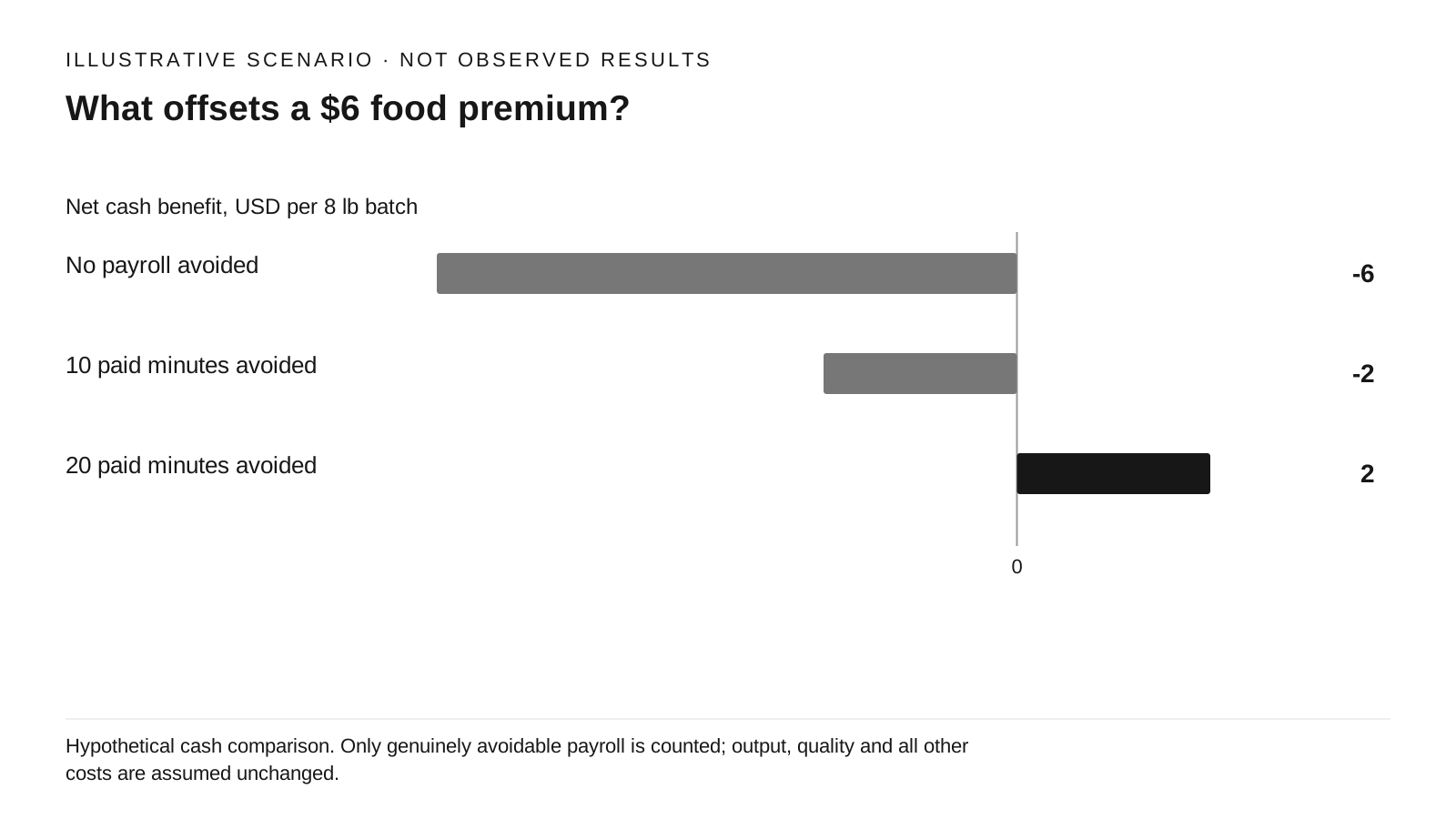
hypothetical scenario · Net cash benefit, USD per 8 lb batch
| Scenario / series | Value |
|---|---|
| No payroll avoided | -6 |
| 10 paid minutes avoided | -2 |
| 20 paid minutes avoided | 2 |
Avoided minutes ÷ 60 × assumed $24/hour − $6 premium. Results: $0−$6; $4−$6; $8−$6.
Hypothetical cash comparison. Only genuinely avoidable payroll is counted; output, quality and all other costs are assumed unchanged.
Source references: Original illustrative calculation; not observed results.
Keep the hypothetical $6 food premium and assume an avoidable labor cost of $24 per hour. If the prepared option truly removes 20 paid minutes for the batch, the avoided cost is $8, leaving a $2 cash benefit. At 10 paid minutes avoided, the benefit is negative $2. If no paid time disappears, the cash result is negative $6. The equal-cost point is 15 genuinely avoidable paid minutes, before any other cost difference.
Preparation time released is not automatically paid time removed. If the team still works the same paid shift, the immediate payroll saving is zero. Released time may instead let the kitchen complete another useful task or serve demand it would otherwise miss. Record that capacity benefit separately, with the additional contribution and costs it actually produces. Do not book both the same minutes as payroll savings and their full capacity benefit.
Yield can reverse the ingredient comparison even before labor enters. At a hypothetical 60% usable yield for the whole option, 8 usable pounds require 13.33 purchased pounds before ordering-rounding, costing $40 at $3 per pound. That is $4 more than the assumed $36 prepared batch. This is a sensitivity test, not a predicted yield. Whole-case ordering, leftovers and extra storage can change the actual cash commitment.
The result can also reverse if prepared product loses usable weight, fails the dish’s quality standard, or arrives in a pack larger than demand can use. Conversely, consistent whole-product quality and available prep capacity can favor doing the work in-house. Keep buying, using and paying for a case distinct: a lower recipe allocation does not necessarily mean a smaller supplier payment this week.
Use a matched-batch record before changing the order
Choose an ingredient and a normal batch with a clearly defined finished-use specification. Compare the existing purchase with a suitable prepared option using the same required output. Keep the recipe and normal handling procedures unchanged. Record purchased and usable quantities, purchase-cost allocation, prep and cleanup time, later unused product, and whether the finished dish meets the same standard.
Repeat across ordinary deliveries rather than selecting the best batch. Calculate food cost per usable pound and the premium or saving for the actual quantity needed. Then identify the specific payroll cost that can disappear, or the specific constrained task that can use the released capacity. If neither benefit is demonstrated, keep it out of the cash-saving claim.
Use the observed range of yields and time differences to test whether the choice holds under a weaker batch. Change the purchase only when the useful output and quality remain comparable and the realized operating benefit covers the full premium. Otherwise retain the current choice or run a narrower test. No universal buying rule follows from this hypothetical example.
Sources & Verified On
Some editorial visuals may be AI-generated and are illustrative, not source evidence.
Verified: 2026-09-24T12:06:48.563Z · Research date and publication date are separate.
- About the Food Buying Guide
USDA Food and Nutrition Service · United States; source-specific educational scope
Published: Not stated · Reference period/event: 2025-08-04 · Retrieved: 2026-09-24T12:06:48.563Z
Designed for Child Nutrition Programs, not a commercial restaurant price survey. Updated August 4, 2025; original publication date not stated. No historical example prices or commodity yields are adopted.
- Vegetables — factors affecting yields
USDA Food and Nutrition Service · United States; source-specific educational scope
Published: Not stated · Reference period/event: 2025-08-04 · Retrieved: 2026-09-24T12:06:48.563Z
Child Nutrition Program planning guidance; no specific restaurant yield is established. Updated August 4, 2025; no food-safety directions or meal-crediting rules are transferred into this article.
- Chapter 13 — Managing Labor Costs
Penn State-hosted Introduction to Food Production and Service · United States; source-specific educational scope
Published: Not stated · Reference period/event: Not applicable / not stated · Retrieved: 2026-09-24T12:06:48.563Z
Teaching reference, not a controlled restaurant trial or current wage benchmark. Undated chapter includes older examples and adaptation notes; none of its wage, tax or productivity percentages is used.