Where packaging, monthly fees, and promotion costs belong
Keep a transaction view, a channel-period view, and a shared-overhead view. A useful allocation should explain the business without pretending every allocated dollar disappears with an order.

View chart data and method
Illustrative: a flat $300 monthly fee and three different monthly order counts. The bill stays $300 within this assumed pricing range.
hypothetical scenario · USD allocated fixed fee per order
| Scenario / series | Value |
|---|---|
| 100 orders | 3 |
| 300 orders | 1 |
| 600 orders | 0.5 |
300/100=3;300/300=1;300/600=0.50
Original illustrative monthly ledger. No actual restaurant records, vendor prices, or contract terms are used.
Source references: Original illustrative calculation; not observed results.
Use three layers of cost
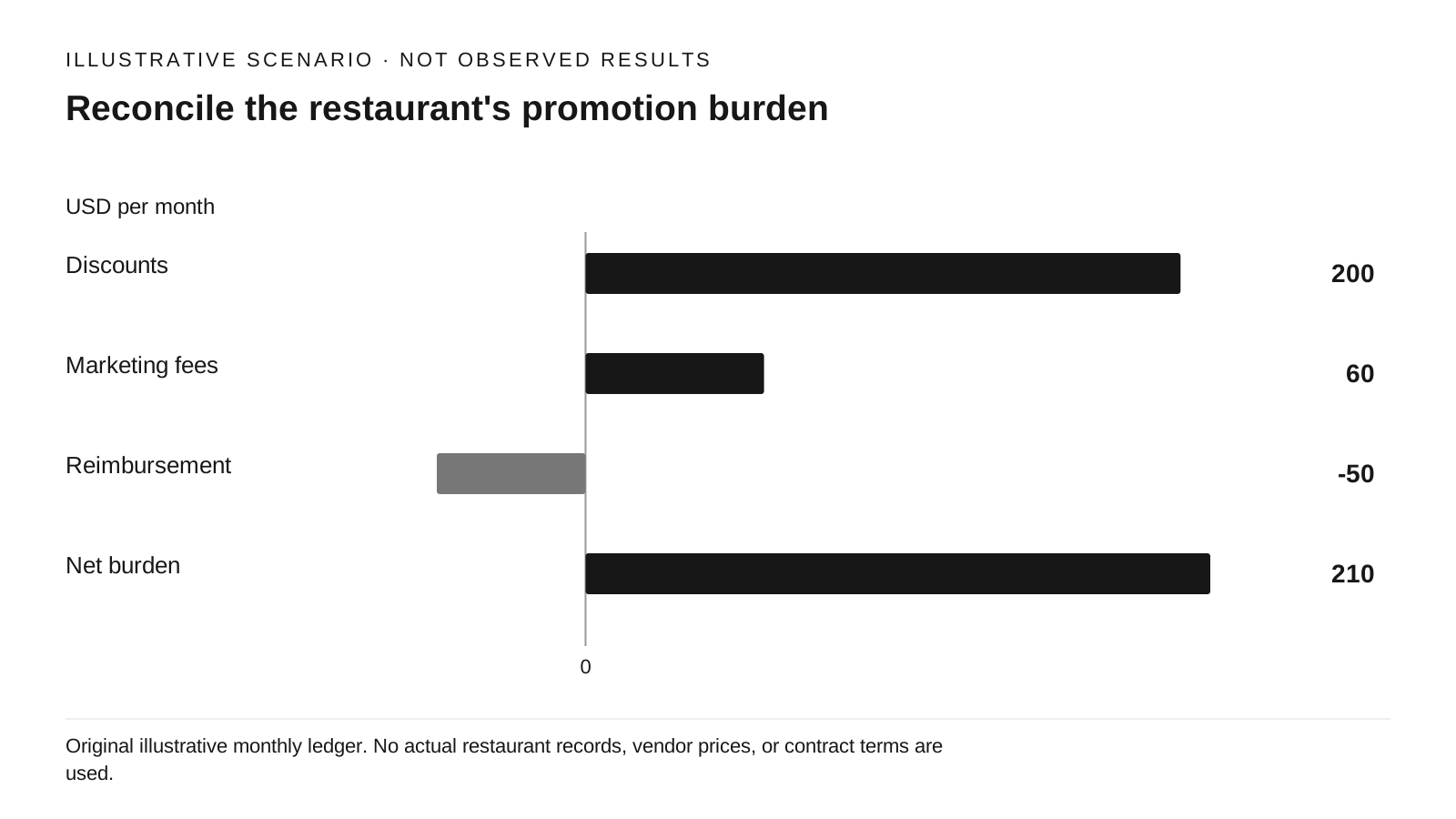
View chart data and method
hypothetical scenario · USD per month
| Scenario / series | Value |
|---|---|
| Discounts | 200 |
| Marketing fees | 60 |
| Reimbursement | -50 |
| Net burden | 210 |
200+60-50=210
Original illustrative monthly ledger. No actual restaurant records, vendor prices, or contract terms are used.
Source references: Original illustrative calculation; not observed results.
Start with transaction contribution: food revenue after merchant discounts, less ingredients, packaging actually consumed, transaction fees, and other variable costs attributable to the order. Next calculate channel-period contribution by subtracting the channel's fixed and additional period costs once. Finally show an explicit share of common overhead if you need a fully allocated management view.
OpenStax distinguishes unit variable costs from costs fixed within a relevant activity range. [S1] That supports the separation; it does not tell you which of your actual invoices is avoidable. A flat subscription, per-order delivery charge, and staff shift can each behave differently when volume changes.
Promotions need a funding bridge. DoorDash's marketing documentation distinguishes fees and discounts from marketing credits and third-party contributions. [S2] A guest-facing discount is therefore not automatically the restaurant's final burden. In an original example, $200 merchant discounts plus $60 marketing fees less $50 confirmed reimbursement equals $210 net burden for the period.
Choose an allocation rule that matches the question
Packaging follows consumption. Attach the actual container, bag, lid, utensils, and included supplies to the relevant order or basket; a menu item needing two containers should not inherit a one-container average without explanation. Buying a case this month is a cash payment, while containers used from that case belong to the orders they serve. Keep those two views reconciled.
A flat $300 monthly channel charge remains a $300 charge whether the month contains 100, 300, or 600 orders. Dividing by those volumes gives $3, $1, or $0.50 per order for a reporting view. It does not mean accepting one more order changes that bill by the allocated amount. A fee tier or minimum can break this flat-cost assumption, so record its threshold.
Align periods before comparing. An annual $1,200 charge corresponds to $100 per month for a simple management allocation, while the actual payment date belongs in the cash plan. A partial month needs an explicitly chosen treatment. When order count is zero, display the $300 monthly charge and an undefined per-order allocation; do not report zero cost or divide by zero.
An allocated loss is not the same as a shutdown saving
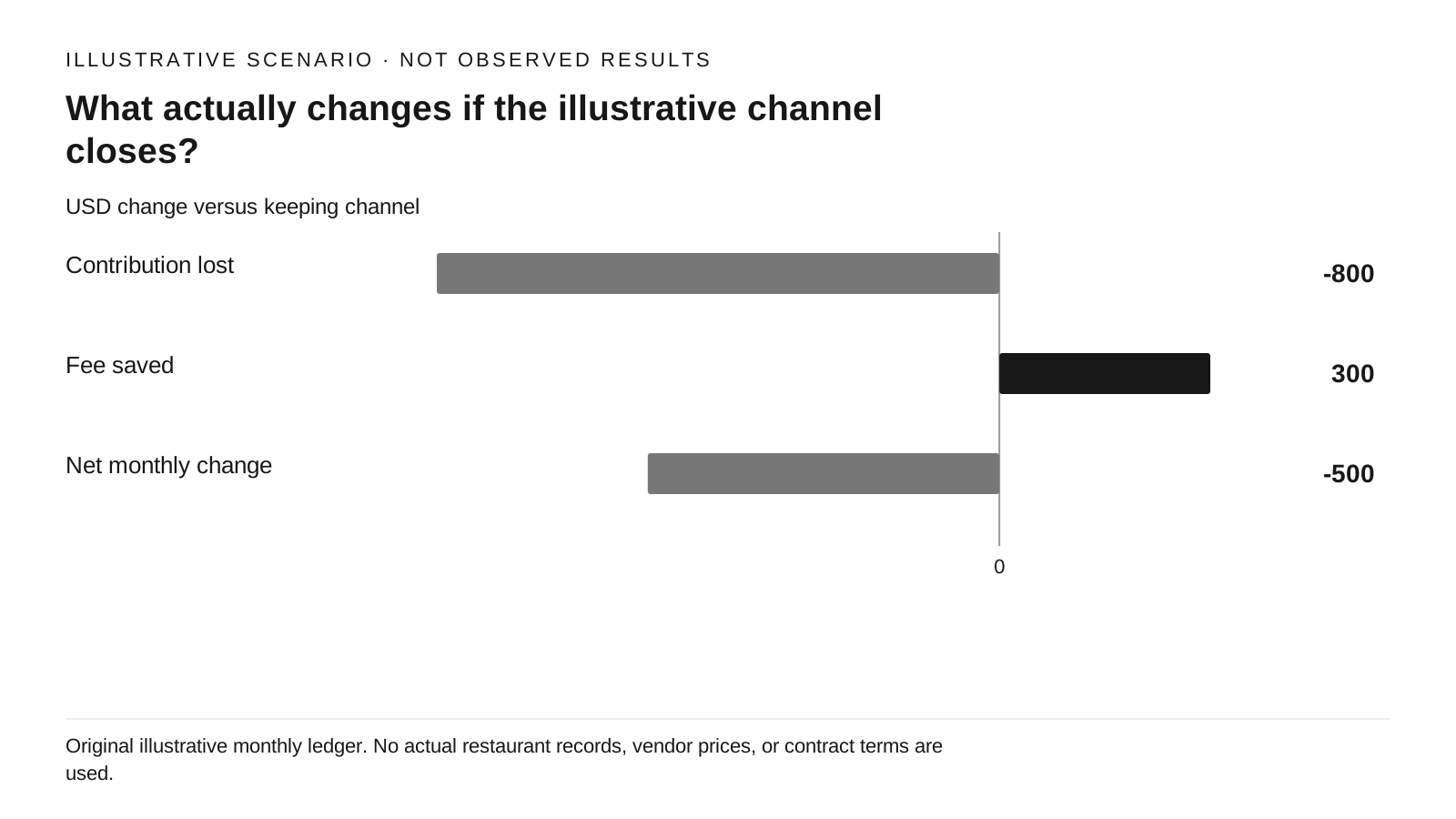
View chart data and method
hypothetical scenario · USD change versus keeping channel
| Scenario / series | Value |
|---|---|
| Contribution lost | -800 |
| Fee saved | 300 |
| Net monthly change | -500 |
-100*8+300=-500
Original illustrative monthly ledger. No actual restaurant records, vendor prices, or contract terms are used.
Source references: Original illustrative calculation; not observed results.
Consider a separate channel illustration: 100 monthly orders contribute $8 each before fixed costs, for $800. A channel-specific $300 monthly subscription leaves $500 toward shared overhead. If management allocates $800 of existing shared rent and salaries to that channel, the displayed fully allocated result is −$300.
Closing the channel does not automatically recover the allocated $800. If the only cost that disappears is the $300 subscription, closing loses $800 contribution and saves $300, making the modeled monthly business result $500 worse. That conclusion assumes the orders are genuinely lost and no valuable capacity is released; if guests migrate to another profitable channel, the comparison must change.
The opposite mistake is to keep every positive-contribution channel forever. Equipment replacement, management time, service disruption, and future staffing can make costs avoidable over a longer horizon. Show the short-run and renewal-period decisions separately. Allocation is useful for asking whether the whole business funds its overhead, but a close-or-keep decision needs actual changes in revenue, cost, and capacity.
Build a ledger that prevents double counting
For each cost, record the source document, period, amount, channel, and behavior: per order, per item, fixed, tiered, or shared. Add a decision column stating whether it changes if the channel is paused today, reduced in volume, or not renewed. Use the contract's actual notice and fee rules as inputs; this article has not reviewed your agreement.
Reconcile one period from orders to settlements. If transaction revenue is already net of merchant discounts, do not subtract those discounts again in the marketing line. If the platform commission includes processing, do not add a second card fee. Keep credits visible and verify whether they were earned and reimbursed in this period before treating them as lasting economics.
Use the Delivery Contribution & Menu Markup Calculator for the transaction view and its explicit monthly-cost scenario. Compare that output with the separate shared-overhead schedule. PP-01 answers which order leaves more contribution; this article answers where each cost belongs and which costs actually change with the decision. Neither layer alone replaces a complete business income or cash-flow statement.
Sources & Verified On
Some editorial visuals may be AI-generated and are illustrative, not source evidence.
Verified: 2026-09-24T02:44:57Z · Research date and publication date are separate.
- Contribution margin per unit, ratio, and total
OpenStax, Rice University · United States; general accounting principles
Published: 2019-02-14 · Reference period/event: Not applicable / not stated · Retrieved: 2026-09-24T02:44:57Z
General accounting reference, not a restaurant loyalty experiment. No textbook figures, worked examples, or extended text reused.
- Marketing 101: How to Use Ads & Promos
DoorDash · United States · Page as retrieved 2026-09-24
Published: 2024-09-18 · Reference period/event: Not applicable / not stated · Retrieved: 2026-09-24T02:44:57Z
Commercial documentation; reconcile with actual contract and statement. No vendor claims of incremental growth adopted as evidence.