Evaluate phone AI by the calls it cannot finish
Test handoffs, uncertain answers, menu changes, and correction work before assigning a value to answered calls. This is a pilot design, not a hands-on product review.
View chart data and method
Illustrative workload model only; no phone AI was used or measured for this article.
hypothetical scenario · staff minutes per month
| Scenario / series | Value |
|---|---|
| Baseline | 400 |
| With AI scenario | 260 |
Baseline=200 calls×2 min=400; scenario=60 transfers×2 min+20 corrections×3 min+80 maintenance min=260; difference=140 min
Invented workload, not a vendor performance estimate. Recovered minutes are not necessarily removed paid hours.
Source references: Original illustrative calculation; not observed results.
Read handoff claims as things to test
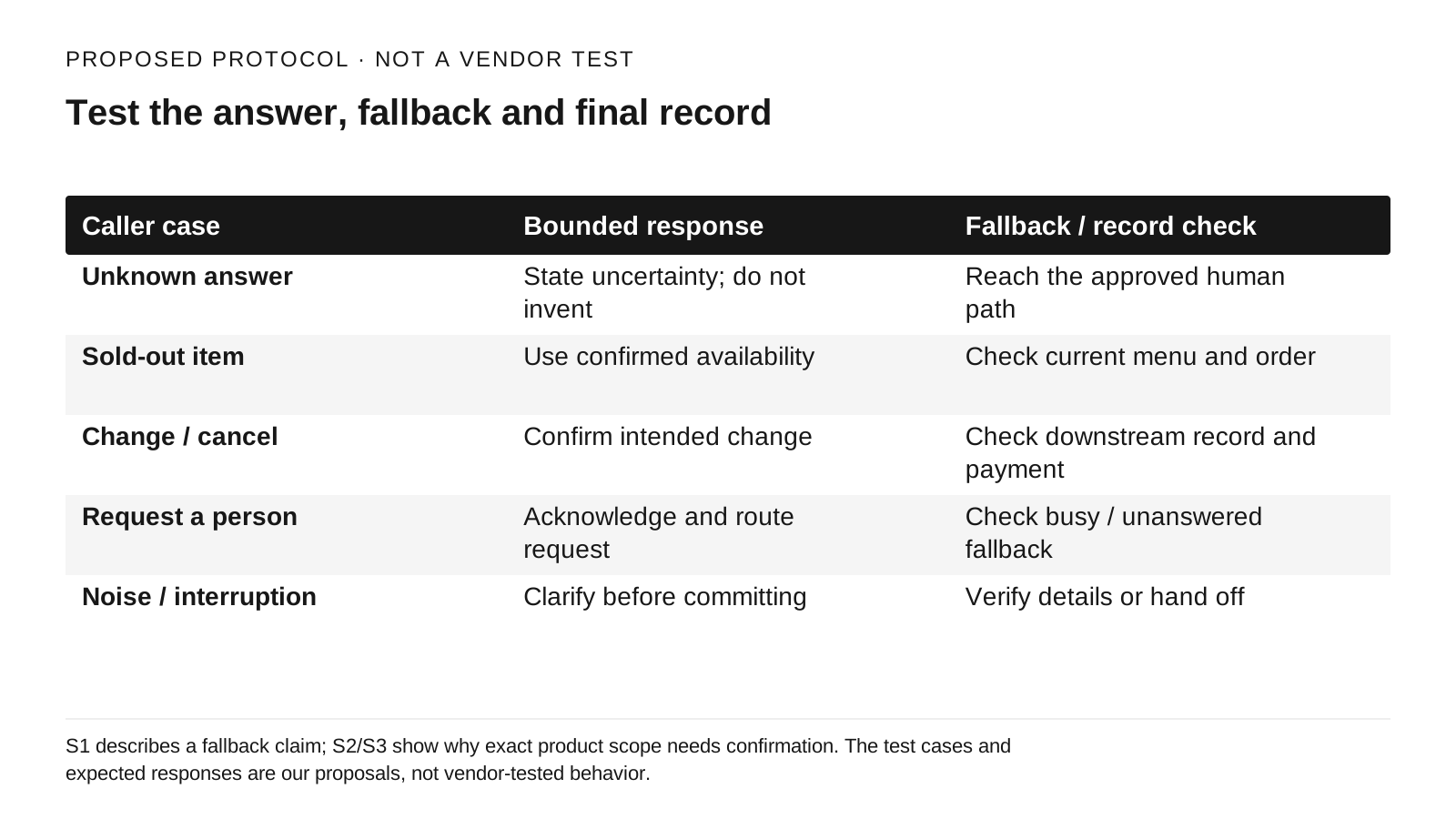
Read the diagram and its basis
proposed protocol
| Caller case | Bounded response | Fallback / record check |
|---|---|---|
| Unknown answer | State uncertainty; do not invent | Reach the approved human path |
| Sold-out item | Use confirmed availability | Check current menu and order |
| Change / cancel | Confirm intended change | Check downstream record and payment |
| Request a person | Acknowledge and route request | Check busy / unanswered fallback |
| Noise / interruption | Clarify before committing | Verify details or hand off |
S1 describes a fallback claim; S2/S3 show why exact product scope needs confirmation. The test cases and expected responses are our proposals, not vendor-tested behavior.
Original editorial explanatory diagram; not vendor evidence
Source references: S1, S2, S3
Slang AI's public FAQ says a question it cannot address can be forwarded to staff or followed by a text with contact information. That describes an offered fallback; it does not show whether your caller reaches an available person or gets the problem solved. We read the page on September 24, 2026 UTC and did not test the service. [S1]
Product scope also needs a dated check. SoundHound's support article last updated December 3, 2023 distinguishes supported POS ordering from basic answering and forwarding for other systems. Its currently accessible restaurant marketing page describes broader OASYS ordering and integration capabilities. These pages alone do not settle the exact product, plan, and integration available to one restaurant today. Obtain current written scope and demonstrate it. [S2] [S3]
Begin with the call types your staff actually encounters: hours, directions, reservations, order changes, unavailable items, complaints, and requests for a person. Separate a system that answers information questions from one authorized to create or modify an order or reservation. A correct spoken response does not establish that a downstream record was created correctly.
Design a script for awkward calls, not only easy ones
Use a synthetic restaurant profile and vendor-supported demonstration first. Prepare the expected answer and escalation for each scripted call. Include a mid-sentence correction, similar-sounding item names, background noise, a caller interrupting, a request outside the configured language scope, and repeated requests for a person. Ask what happens when the destination line is busy or nobody answers.
For facts that are not in the approved restaurant information, the desired outcome is a bounded response and an appropriate human path, not an invented answer. Requests involving ingredients, allergies, or other matters requiring staff judgment should follow the restaurant's established escalation process. This test does not validate food safety or authorize an AI system to make safety assurances.
Test changed hours, an unavailable menu item, and a changed reservation in the proposed connected systems. Record which system is authoritative, who updates it, how the change is confirmed, and whether the phone answer and downstream record agree. Use only synthetic caller details in the demonstration. Before any real-caller pilot, resolve the provider's recording, retention, access, disclosure, and deletion requirements for your operation; this article does not determine legal compliance.
Value resolved work and incremental orders separately
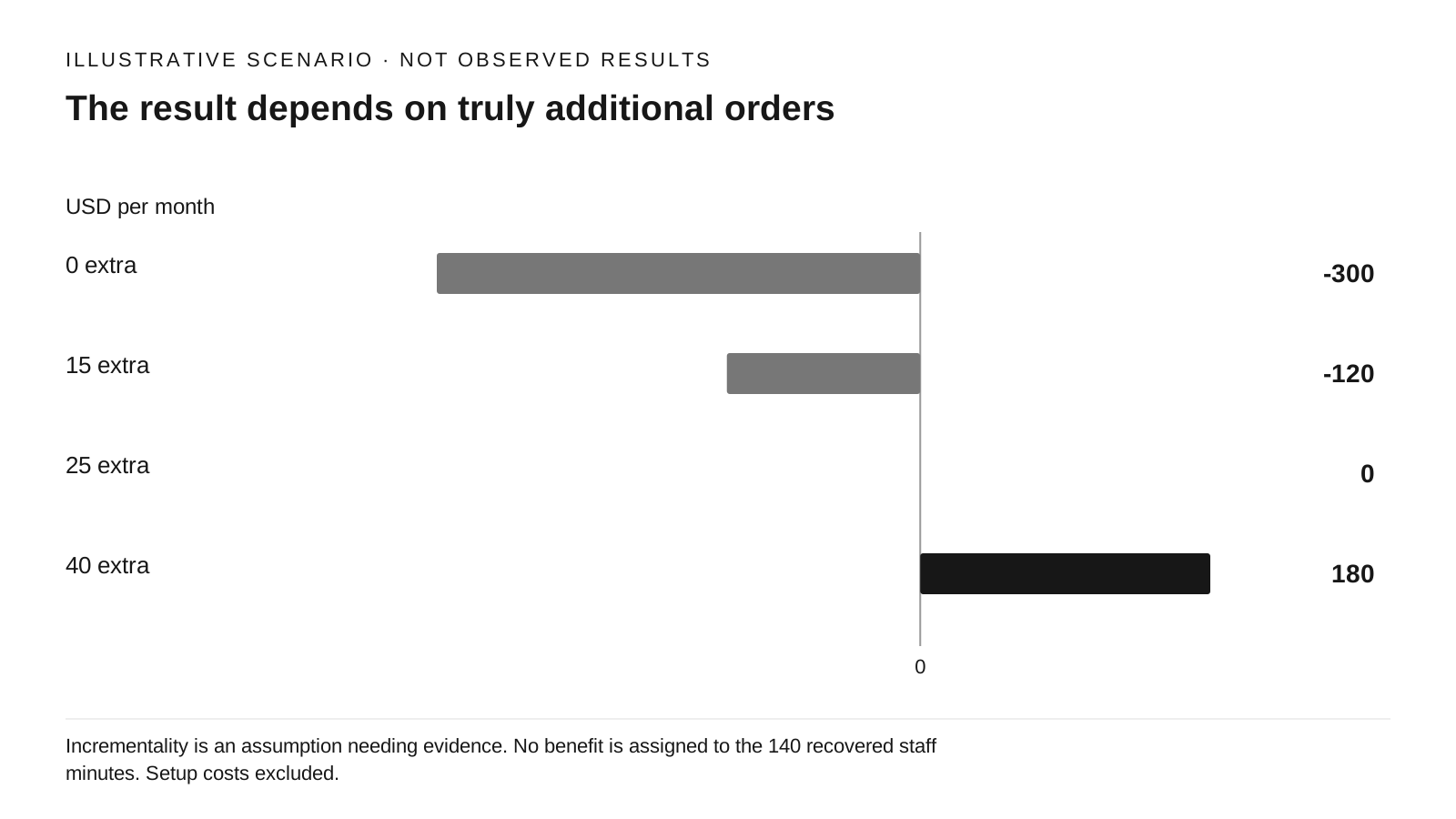
View chart data and method
hypothetical scenario · USD per month
| Scenario / series | Value |
|---|---|
| 0 extra | -300 |
| 15 extra | -120 |
| 25 extra | 0 |
| 40 extra | 180 |
Contribution change=incremental paid orders×12−(200+40+60)
Incrementality is an assumption needing evidence. No benefit is assigned to the 140 recovered staff minutes. Setup costs excluded.
Source references: Original illustrative calculation; not observed results.
Our hypothetical monthly baseline is 200 calls requiring two staff minutes each, or 400 minutes. In a trial scenario, 60 transfers consume two minutes each, 20 corrections consume three minutes each, and menu/profile maintenance takes 80 minutes. Remaining work is 260 minutes, leaving 140 minutes potentially available for other tasks. These are invented inputs, not an expected result from any named vendor.
If staff remain on the same paid shifts, the 140 minutes do not reduce payroll cash. They may improve attention to guests or relieve interruptions, but that benefit needs its own observation. Do not multiply recovered minutes by wages, add the result to avoided labor cost, and count the same benefit twice. Also do not count every AI-taken order as a new sale; some callers would have ordered online or reached an employee anyway.
For a separate cash illustration, assume $200 subscription, $40 telecom/usage, and $60 additional remake or refund cost per month, with paid labor unchanged. At $12 contribution per genuinely additional paid order before these AI-specific costs, the break-even is 25 incremental orders: $300 ÷ $12. Zero, 15, 25, and 40 incremental orders produce −$300, −$120, $0, and $180 respectively. The comparison excludes setup cash and other unchanged overhead and is not a forecast.
Agree on the stop conditions before a pilot
Classify each scripted case as resolved correctly, transferred and resolved, unresolved, abandoned, or wrong action. Track the count of eligible calls and the cases not tested. Record time spent by staff on transfers, repeated explanations, corrections, and information maintenance. An answer-rate headline without these outcomes is incomplete for an operating decision.
Define critical failures before evaluation, such as an unsupported factual assurance, an incorrect committed order, or a failed human path with no usable fallback. A critical failure should trigger investigation and retesting rather than disappear inside a favorable average. Do not make a universal acceptable error threshold; the consequence and the permitted task scope determine the owner's decision.
If a later authorized pilot involves real service, compare similar call windows and examine whether phone gains are offset by fewer online or staff-taken orders. Demand, promotions, and call mix can change at the same time. Without a defensible baseline, label incremental sales unknown. Buy only if the demonstrated scope, unresolved risks, total cost, and measured operational benefit support your decision. No provider account was created and no calls, integrations, or purchases were made for this article.
Sources & Verified On
Some editorial visuals may be AI-generated and are illustrative, not source evidence.
Verified: 2026-09-24 · Research date and publication date are separate.
- Slang AI — public product page and frequently asked questions
Slang AI · U.S. restaurant product marketing; exact service scope requires confirmation · Public FAQ; no plan, demo, or live account tested
Published: Not stated · Reference period/event: Not applicable / not stated · Retrieved: 2026-09-24
Marketing claim, not a verified resolution rate. No visible source publication date; no ROI/accuracy/time-saving claims adopted.
- Does the voice assistant integrate with my POS?
SoundHound · Restaurant support documentation; account eligibility unknown · SoundHound for Restaurants support page dated 2023-12-03
Published: Not stated · Reference period/event: Support page last updated 2023-12-03; original publication date unknown · Retrieved: 2026-09-24
Older product-scope page; not a complete current compatibility list. Its scope is not assumed to match present OASYS marketing or a merchant quote.
- AI for Restaurants & QSR
SoundHound · Restaurant product marketing; account eligibility unknown · OASYS marketing page; specific plan/version not tested
Published: Not stated · Reference period/event: Not applicable / not stated · Retrieved: 2026-09-24
Broad company positioning does not resolve exact integration/plan availability. No marketing revenue, speed, or accuracy metrics treated as independent evidence.