Price a restaurant system beyond its monthly software fee
Compare payment volume, transaction count, devices, add-ons, and exit costs on the same operating assumptions. A public price page is the start of the worksheet, not your final quote.
View chart data and method
Unbranded example only: no number is a quoted Square or Toast price.
hypothetical scenario · USD per month
| Scenario / series | Value |
|---|---|
| Software | 99 |
| Add-ons | 60 |
| Processing | 1500 |
Processing=50000×0.026+2000×0.10=1500; total=99+60+1500=1659
$50,000 processing fee base and 2,000 transactions; excludes setup, tax on vendor charges, refunds and other fees.
Source references: Original illustrative calculation; not observed results.
Read the unit attached to each fee
View chart data and method
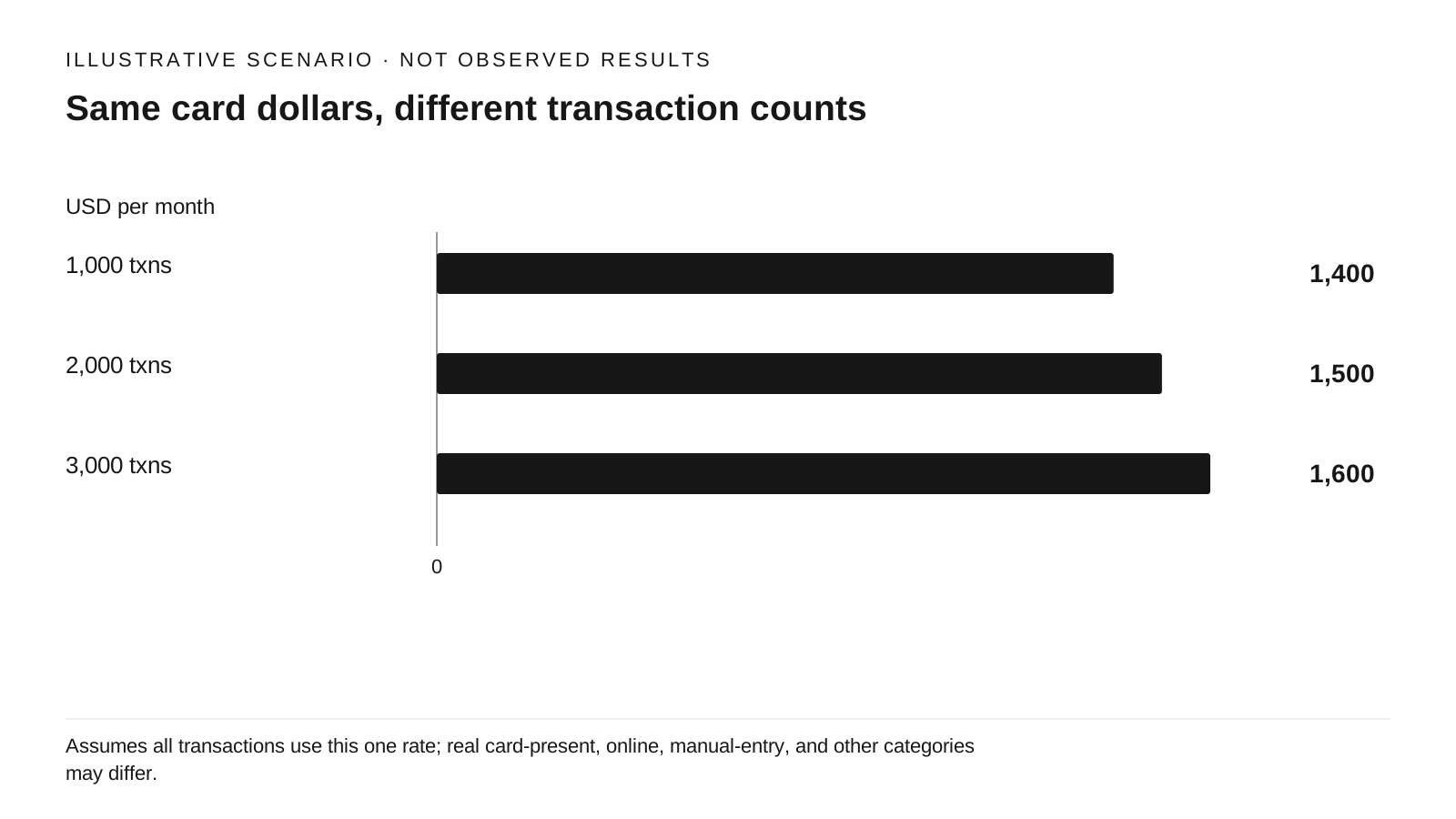
hypothetical scenario · USD per month
| Scenario / series | Value |
|---|---|
| 1,000 txns | 1400 |
| 2,000 txns | 1500 |
| 3,000 txns | 1600 |
50000×0.026 + transaction count×0.10
Assumes all transactions use this one rate; real card-present, online, manual-entry, and other categories may differ.
Source references: Original illustrative calculation; not observed results.
Square's U.S. pricing page, read September 24, 2026 UTC, says its KDS app is billed per device in addition to the applicable paid plan. Its U.S. fee documentation says processing fees apply to the transaction total including tax and tip. These company documents illustrate two checks: the billable unit and the fee base. They are not a quote for your location or a ranking of systems. [S1] [S2]
Create one line for each charge: rate, unit, number of units, billing period, included allowance, overage rule, and source date. Mark whether the figure comes from a public page, a written offer, or an assumption. Ask whether an add-on is per location, device, employee, order, message, or account; multiplying the wrong unit can overwhelm a small advertised saving.
In the unbranded illustration, a 2.6% plus $0.10 processing charge on $50,000 costs $1,400 at 1,000 transactions, $1,500 at 2,000, and $1,600 at 3,000. The card dollars are identical, but smaller tickets create more fixed transaction charges. These invented rates demonstrate the calculation and must not be treated as current vendor defaults.
Normalize the quote before comparing the total
Build the same operating basket for each option: locations, counters, handhelds, kitchen screens, online channels, required integrations, and support coverage. Separate a feature that is included from one that needs another product or partner fee. A box marked supported is not evidence that your specific printer, menu structure, or integration version will work; the order-path test in the related guide addresses that next.
For processing, group expected transactions by the pricing categories in the written offer. Calculate each category as its fee-base dollars × percentage plus its chargeable transaction count × fixed fee. If the terms have minimums, tiers, interchange pass-through, or distinct refund treatment, use that structure rather than forcing it into a flat-rate formula. Leave an unknown as unknown until the applicable terms are available.
Request a written inventory of implementation, training, migration, replacement hardware, shipping, required services, renewal, notice, and exit charges. Record the end date and the documents that specify each obligation. This is a purchasing worksheet, not a judgment about contract enforceability. Do not assume a cancellation promise for one software subscription also settles separate hardware or financing commitments.
Show first-year cash and ongoing cost separately
View chart data and method
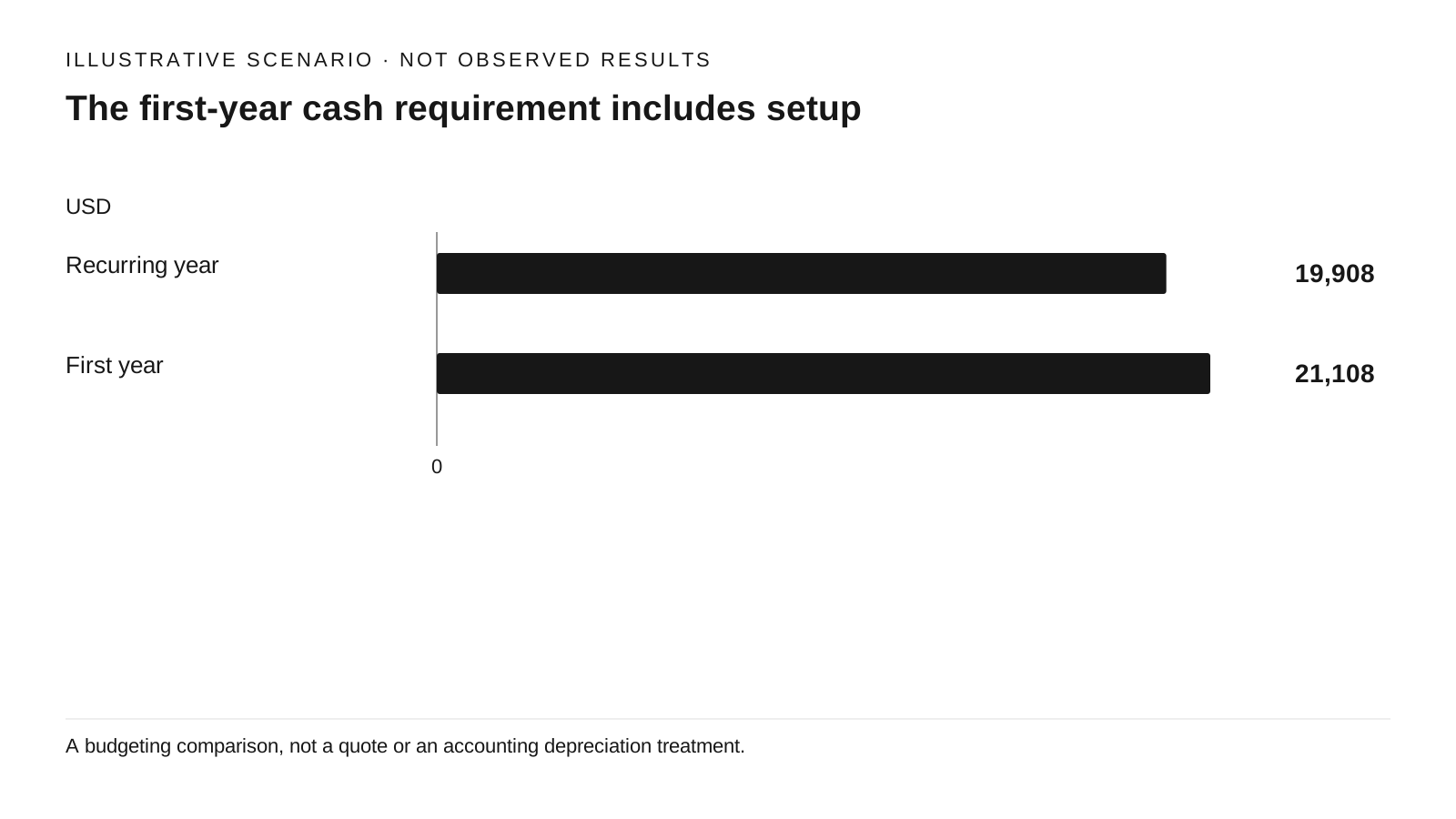
hypothetical scenario · USD
| Scenario / series | Value |
|---|---|
| Recurring year | 19908 |
| First year | 21108 |
Recurring=12×1659=19908; first year=19908+1200=21108
A budgeting comparison, not a quote or an accounting depreciation treatment.
Source references: Original illustrative calculation; not observed results.
At the example's $99 software fee, $60 add-ons, and $1,500 processing, the recurring monthly total is $1,659. Twelve unchanged months cost $19,908. Add $1,200 paid upfront for implementation and hardware, and first-year cash becomes $21,108. Report both figures; dividing setup by twelve is useful for comparison but does not make its payment monthly.
A higher monthly subscription can still have a lower modeled total. Suppose an otherwise identical alternative costs $100 more per month and cuts the percentage processing component by 0.3 percentage points, with the fixed transaction charge unchanged. It breaks even at $100 ÷ 0.003 = $33,333.33 in monthly fee-base volume. Above that, the modeled fee saving exceeds the extra subscription. This is conditional arithmetic, not a forecast or a claim that either offer exists.
Check a low-volume month and the full expected channel mix before making a choice. A rate saving on in-person payments may matter little if much of your volume uses another category. Also keep migration labor, required retraining, and failed-order recovery visible. Do not convert an untested claim of time saved into guaranteed payroll savings.
Require a quote you can reconcile to a bill
Ask each seller to price the same basket and transaction mix, and to identify every assumption that could change the total. Preserve the dated quote beside the public page. Include who pays for each integration and how support works outside normal hours. A feature that cannot be demonstrated on the proposed setup should remain unverified.
Before committing, choose a comparison period, calculate the recurring and first-year totals, and write a separate exit scenario using only documented charges. Record an owner decision beside unresolved items: obtain evidence, test a function, accept a known limitation, or decline. Do not replace an unknown with zero just to finish a ranking.
If you later adopt a system, reconcile its first actual statement line by line to the model and investigate unexplained differences. The Delivery Contribution Calculator can help translate verified per-order channel costs into menu contribution, but a whole-system purchasing decision also needs the recurring and implementation costs described here.
Sources & Verified On
Some editorial visuals may be AI-generated and are illustrative, not source evidence.
Verified: 2026-09-24 · Research date and publication date are separate.
- Square Processing Fees, Plans, and Software Pricing
Square · United States · Public Square Plus/Premium KDS billing description; no written merchant quote
Published: Not stated · Reference period/event: Not applicable / not stated · Retrieved: 2026-09-24
No visible publication date; plan terms can change. No current vendor dollar amount is reproduced; all numerical examples are invented.
- Learn about Square fees
Square · United States · Public U.S. support documentation; account-specific terms not inspected
Published: Not stated · Reference period/event: Not applicable / not stated · Retrieved: 2026-09-24
Not a statement that every processor uses this basis. No merchant statement or contract was reviewed.