Evaluate a limited menu test beyond units sold
A useful trial reconciles availability, paid selection, repeat opportunity, waste, and contribution before the item earns a permanent place.
View chart data and method
Illustrative fully closed batch: no usable ending inventory or transfers remain. Samples are a separate use, not paid demand.
hypothetical scenario · portions
| Scenario / series | Value |
|---|---|
| Paid sales | 60 |
| Discarded | 12 |
| Samples | 8 |
80 produced = 60 sold + 12 discarded + 8 samples.
Portions must have a consistent recipe size. Real records also need ending stock, transfers, staff meals, refunds, and other documented uses.
Source references: Original illustrative calculation; not observed results.
Decide what the test must establish
View chart data and method
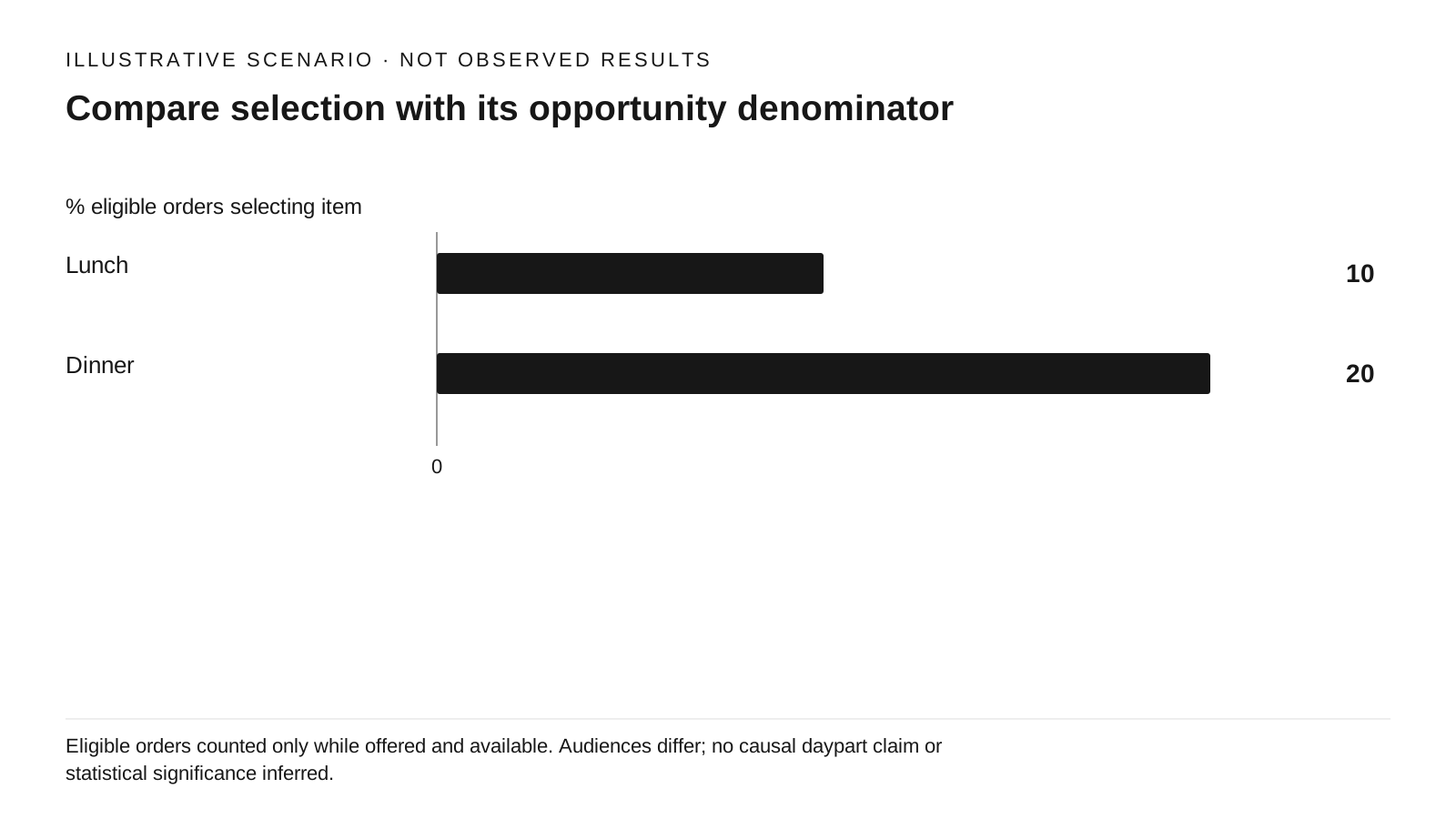
hypothetical scenario · % eligible orders selecting item
| Scenario / series | Value |
|---|---|
| Lunch | 10 |
| Dinner | 20 |
12/120×100=10; 48/240×100=20.
Eligible orders counted only while offered and available. Audiences differ; no causal daypart claim or statistical significance inferred.
Source references: Original illustrative calculation; not observed results.
Before the first sale, state the decision: keep, revise, retest, or remove a specific recipe and offer. Record its price, portion, channel, daypart, menu placement, batch size, planned duration, and maximum test spending. The goal is to learn whether the item adds useful contribution under workable service conditions, not to produce a large sales count.
EPA's food-service resources recommend measuring wasted food and recording its amount, type, and reason. [S1] Pair those records with paid orders and availability. If you prepare 80 portions and sell 60, the other 20 cannot be silently priced as though they were sold. The illustration reconciles them as 12 discarded and 8 samples; actual remaining usable inventory needs its own entry.
Record selection as orders containing the test item divided by eligible orders during the defined offer. In a hypothetical lunch service, 12 selections among 120 eligible orders is 10%; dinner's 48 among 240 is 20%. Dinner's higher rate may reflect a different occasion or audience. It does not prove changing the daypart caused the difference.
Keep test conditions and repeat windows visible
NIST's experimental-design guidance explains controlling important nuisance factors in blocks and randomizing within an appropriate design. [S2] Adapt the principle cautiously: compare like dayparts and weekdays, and record events, staff changes, promotion, price, and availability. A simple before-and-after restaurant trial is still vulnerable to confounding; this protocol does not turn it into a randomized experiment.
Do not classify orders after a sellout as rejected demand. Keep total eligible-period orders, available-period orders, and stockout minutes visible so the exclusion cannot make weak supply look like strong conversion. If supply was persistently unavailable, the selection result is incomplete and the trial needs a revised production or observation plan.
For repeat purchase, choose a window appropriate to the normal buying occasion before seeing results. Use an existing permitted customer identifier only when available; report tracking coverage. Suppose 60 identifiable first buyers exist, but only 40 have the full window and the required scheduled days of item availability, whether or not they visited again. If 10 buy again, the observed rate is 25% of those 40, not 16.7% of all 60. Do not restrict the denominator to people who returned to the restaurant. Even 25% is a selected cohort result, not a causal retention lift. If repeat tracking is unavailable, mark it unavailable.
Cost the whole batch, then compare the whole menu
View chart data and method
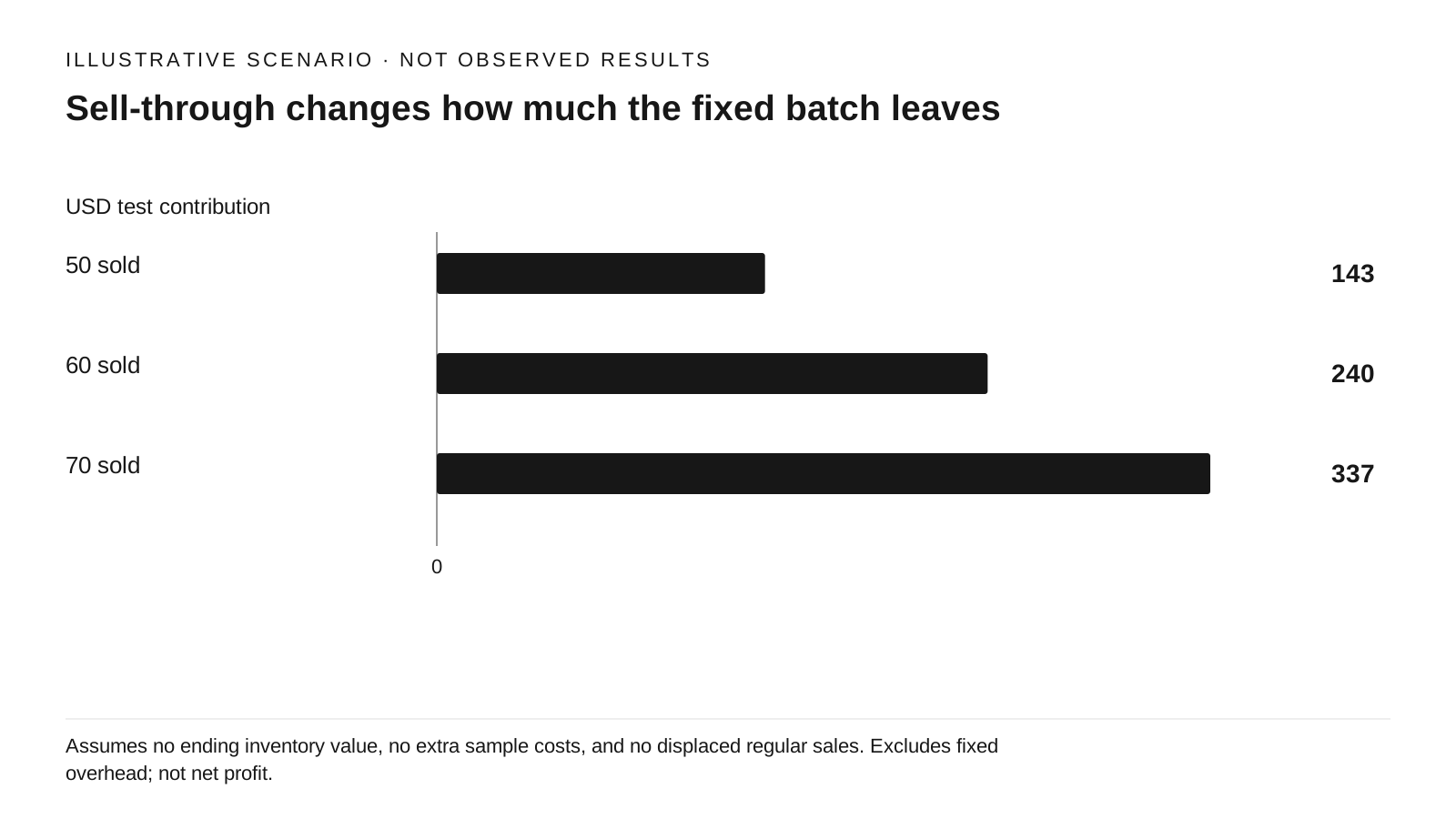
hypothetical scenario · USD test contribution
| Scenario / series | Value |
|---|---|
| 50 sold | 143 |
| 60 sold | 240 |
| 70 sold | 337 |
Q×(10-0.30)-240-42-60 = 9.7Q-342.
Assumes no ending inventory value, no extra sample costs, and no displaced regular sales. Excludes fixed overhead; not net profit.
Source references: Original illustrative calculation; not observed results.
In our hypothetical batch, 80 portions cost $3 each to produce in ingredients, including the food used for samples and discarded portions. Sixty portions sell for $10. Deduct $18 in variable fees, $42 in additional paid labor, and $60 in one-time setup from $600 revenue and $240 ingredients. The test leaves $240 before fixed overhead and displaced regular-menu contribution.
Do not deduct the 12 wasted portions a second time: they are already in the $240 batch ingredient cost. Conversely, if your item margin includes ingredients only for sold portions, add unsold and sampled food separately. Extra sample packaging or labor also belongs in the ledger if incurred; our calculation assumes none beyond the listed costs.
Holding the 80-portion batch and other fixed test spending constant, with a $0.30 fee for each sale, 50 paid portions leave $143, 60 leave $240, and 70 leave $337. This sensitivity is not a demand forecast. A regular item displaced by the trial would reduce the incremental result further, so compare total menu contribution and mix across comparable periods.
Use decision rules that admit an inconclusive result
Review the record in this order: data completeness, paid selection, contribution after all test costs, service impact, repeat opportunity, and waste reasons. Set the economic and service thresholds from your restaurant's requirements before the trial. There is no universal sales count, waste rate, or repeat rate that makes a limited-time item a success.
Keep the offer if the evidence meets the planned criteria with repeatable prep and acceptable service. Revise one identified weakness when the paid demand is promising but the portion, process, or cost needs work. Stop if a material operational problem or persistently inadequate contribution remains. Use inconclusive when exposure, supply, cohort tracking, or comparable-period evidence is insufficient.
Save the recipe version, exact test dates, raw counts, denominator rules, costs, exclusions, and decision. Separate a sold-out first weekend from sustained demand. A later menu change should cite the recorded result and limitations; it should not rewrite a weak trial as a success because the item eventually became familiar.
Sources & Verified On
Some editorial visuals may be AI-generated and are illustrative, not source evidence.
Verified: 2026-09-24T02:47:29Z · Research date and publication date are separate.
- Tools for Preventing and Diverting Wasted Food
U.S. Environmental Protection Agency · United States · Page last updated March 22, 2026
Published: Not stated · Reference period/event: Not applicable / not stated · Retrieved: 2026-09-24T02:47:29Z
Waste guidance does not validate menu demand, a repeat rate, or this trial protocol. No food-safety limit or savings estimate adopted.
- Randomized block designs
NIST/SEMATECH e-Handbook of Statistical Methods · General experimental methods; U.S. publisher · Section 5.3.3.2
Published: Not stated · Reference period/event: Not applicable / not stated · Retrieved: 2026-09-24T02:47:29Z
Engineering methodology, not a validated restaurant trial. Matched service periods alone do not randomize treatment or establish causation.